Do We Still have a Capitalist Economy?
In this Upriver Current article, Dr. Ryan Mattson, economist and author of the Upriver Press book titled Inequality by Design (2025), helps us think more clearly about how the economic rules continue to be set up to benefit the wealthiest people while hindering the futures of most Americans. Using the right wording, he argues, is important.
By Dr. Ryan Mattson
Greg Ip editorialized in The Wall Street Journal that the US is “marching toward state capitalism.” What in the John Maynard Keynes is state capitalism?
To understand the term and what it implies today, we must take a basic approach to what economists call “comparative economic systems.” This is the study of the differences among national economies. We can present those differences by using a matrix of “planned” versus “market” systems.
In a planned economic system, a central authority determines production, allocation, and consumption. A government tells you what to produce, how much to produce, who gets it, and how much is consumed. In a market system, decentralized actors determine the production, allocation, and consumption.
In reality, we in the US participate in a mix of these two categories. Some products and services are produced according to a planned system and some are left to the market.
We can categorize most economic systems into who owns and who controls the factors of production. Does a central authority determine how much capital and labor go into making a product or service? Or is this left to the market to decide? Who owns the labor and capital that go into this production, and thus who gets the returns?
A quick and overly simplified history of economic systems can illustrate what I mean. From about the ninth to the fifteenth century, most European economies were feudal; that is, the nobility owned the factors of production and controlled them. Serf labor was tied to the land.
As the medieval period closed and European kingdoms expanded, mercantilism arose in the fifteenth to the nineteenth century. The nobility still owned and controlled the land and the wealth produced by the peasantry, but as the centuries went on, merchants began to gain power by consolidating their negotiating power into larger guilds. Individuals also began to eventually own and control their own, albeit small, factors of production.
By the end of the eighteenth century, both Adam Smith’s laissez faire ideals and the Parisian mob “convinced” the nobility that the modes of production needed to be in the hands of merchants and individuals. Since the early nineteenth century, economic history has been dominated by the liberal, capitalist order.
According to the Boston University Global Development Policy Center’s Capitalism and Socialism in the 21st Century (BUGDP), we can broadly categorize most economic systems along a two-by-two matrix of state-owned or individual-owned factors of production. I reproduce their matrix here, as I did when I was teaching this topic in a macroeconomics class in 2023.
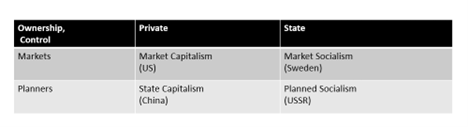
This is a lovely table. Basically, if markets control and individuals own the factors of production, we have a market capitalist system. BUGDP lists the US as an example. By comparison, if markets control the means of production but the state owns them, then we are in a market socialist system, like Sweden. If planners control the means of production and private individuals own them, then we are in a state capitalist system, like China. If planners control the means of production and the state owns them, then that is planned socialism, like the former USSR.
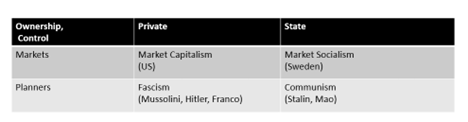
I really like the BUGDP description because it matches closely with the one I learned about when I was the teaching assistant for Dr. Harry Shaffer at the University of Kansas. Harry was an economist from Austria who fled Nazi Europe. He stayed in Cuba (before Castro!) and then came to the US. So, he lived under different economic systems. Harry’s matrix was very similar to the BUGDP framework, with a few key differences in vocabulary.
So where are we today?
When Greg Ip used the term state capitalism in his article, he used the wrong words. The US government is now, without a doubt, taking more control of the factors of production by leveraging pressure on private firms. This is not state capitalism. It should be defined as economic fascism. We are seeing the gradual rise of a powerful state central planner that allows private firms to own the factors of production.
Another wrong term, crony capitalism, is also frequently used to describe trends in the US. For example, the popular economist Justin Wolfers used it during a September 2025 NPR interview to explain the current administration’s economic policies.
The problem is that crony capitalism implies that the system’s corruption is limited to a small group of powerful and wealthy individuals. Hower, the rules that foment inequality—benefitting the wealthiest Americans while hampering the prospects of everyone else—are institutional and systemic. The definition of crony capitalism is too narrow to describe what is going on.
During his NPR interview, Professor Wolfers discussed Apple and Nvidia, two of the largest corporations in the world. The government’s influence on these corporations exemplifies economic fascism. Crony capitalism is like dealing with Don Corleone. Economic fascism is like living under Mussolini. The former requires individuals to pay respect to la familia nostra in hopes that they do not put a severed horse in your bed. The latter is imposed by armaments and a compliant court system.
For those who hope for better times, I have bad news. Economic fascism is gradually being institutionalized. Let’s stop tiptoeing around what is going on and call it what it is: the (economic) fascists want control. Our book, Inequality by Design, will help you think about this issue more carefully, and we offer some practical ideas for how to move the country in a better direction.