The Artistry of Writing Biographical Dramas
An Interview with Dr. Tee O’Neill
Dr. Tee O'Neill is an award-winning and internationally acclaimed playwright. Her plays have garnered elite recognition, including an Edward Albee award. Dr. O’Neill has earned an international residency at the Royal Court Theater in London and a Winston Churchill Fellowship. She has taught scriptwriting and dramatic structure for many years, includat New York University, Siena College, and Melbourne University. Her plays have been performed by the Melbourne Theater Company, the Sydney Theater Company, and many other groups. When she’s not writing plays, she runs an equine therapy center where she lives in Australia.
Dr. O’Neill’s book, Writing the Biographical Drama, which Upriver Press published in 2025, is one of a kind. Despite the popularity of biographical films and plays, there are no other books about this unique form of writing. Her book was endorsed by José Rivera, who was nominated for an Academy Award for his script The Motorcycle Diaries, a biographical drama about Che Guevara.
In her book, Dr. O’Neill offers chapters on the following topics: legal issues; selecting a compelling person to portray; how to conduct research; character development; narrative structures and principles of drama; elements of the writing process; feedback and public readings. It’s a practical, inspiring book for playwriting and screenwriting students in universities and/or amateur writers who want to develop their talents.
Glenn: Let me start by asking to you to describe how you became interested in writing biographical dramas.
Tee: Some years ago, I was asked to write about an Australian footballer named Ron Barassi. I was immediately taken with the project. He was a person who loomed large in my childhood. He was probably one of the first sports stars in Australia. I used to watch him a lot on television as a child. I came from a football-loving family, and I played football myself as a youngster. I was excited to be asked to write this play, but I was also filled with trepidation because up to then I had only written fictional plays. I knew I needed help, but I couldn’t find any books or manuals about this form of writing. Eventually, I decided to focus my PhD work on this genre, which then led to my book.
Glenn: Biographical dramas are extremely popular in both film and theater. So, what are the elements of a biographical drama? And what makes this art form so culturally influential?
Tee: I think there's a lot of reasons why people love biographical drama. Humans are naturally curious about other people. One scholar said that we are the only species who have this type of natural curiosity. I dispute that because I live on a farm and I can tell you that all the animals are very interested in what I'm doing! Especially my cows. I've got five and they are always chasing me. Nevertheless, we humans are really interested in other people's lives.
Glenn: It seems there’s something deeper than biology, though. Right?
Tee: At a deeper level, there's something about watching a biographical drama that helps us live our own lives. We get the chance to watch another person go through some extreme events. That helps us to see how we perhaps will cope with the stresses and strains of our own lives. Biographical films and plays can develop empathy for others.
Glenn: It seems like we learn a lot about the individuals in these plays and films, which I enjoy.
Tee: There is certainly an educational element, but there's also an entertainment factor. Biographical dramas are not documentaries. That's what makes this genre so fascinating. The writer is making choices about what aspects of the subject’s life to dramatize.
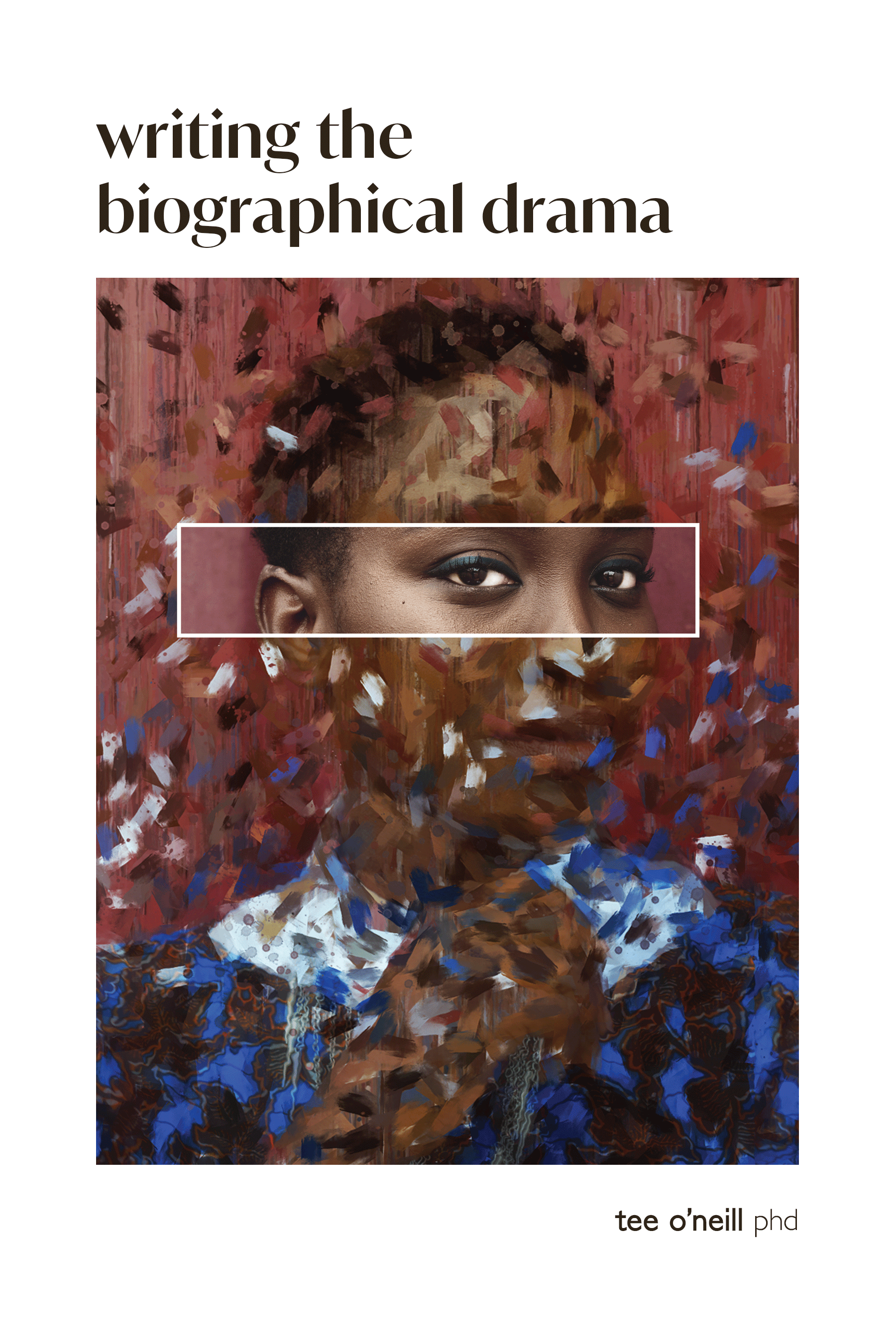
Glenn: That interaction between the facts and artistic freedom is one of the things that our graphic designer portrayed on the cover. It has an impressionistic style, showing the relationship between the writer’s viewpoint and the true person.
Tee: Yes, that is what happens when you write a biographical drama. It's the writer’s take on the person's life. In a way, writing a biographical drama is closer to a portrait painter than, say, a journalist or a historian. We do present factual elements of the subject’s life, but then we create a drama from that. The story comes from the facts, but it also comes from the writer’s heart. It's about how we can make the facts into a dramatic experience.
Glenn: It seems like this might raise ethical dilemmas for the writer. Your book has a chapter designed to help writers consider their own personal biases and their ethical responsibilities in portraying the person.
Tee: The writer brings her own perceptions of that person to the script. She’s overlapping those perceptions and ideas with the facts of the story. I think it's beautiful. But I encourage writers to stop and think about their own personal biases and their ethical responsibilities. Beyond the ethical responsibilities, writers also need to take stock of what they believe is important in life to them. That will be a driving force in the writer’s choices and motivations. Many times, writers are attracted to writing about a person because there's something about the subject's life that helps them understand their own lives.
Glenn: Your book elegantly addresses this balance between being faithful to a factual narrative while also including your artistic license.
Tee: There is a point where, yes, you need freedom as a writer. You need to be confident in your own story, your own take. Writers need to take a good look “under the hood,” considering their biases and motivations as we research the person thoroughly. We need to look at the facts and then say, “This is my take on this story.”
Glenn: You are doing a lot of interesting work these days on the process of creativity. You told me that you’re learning a lot from horses!
Tee: I'm fascinated with that topic—how to be more creative, how creativity works. When I did my PhD, I looked at the science of creative flow. I learned that we've got to allow our prefrontal cortex to kind of “go to sleep” and just be in touch with our limbic system. My horses do this. They are not thinking about the past or the future. They do not have any emails to answer or bills to pay. Horses live in the present moment. And that's what we need to do as writers when we're creating our work. We need to be in the present tense. This is one reason why I am fascinated with how equine therapy can help people with their creativity. I think that equine therapy can help us be a lot more creative!
Glenn: One of the great aspects of your book is that you include some of the first-person interviews you held with many of the best playwrights and screenwriters in the business, including people like Academy Award-nominated José Rivera. Let me close our conversation by sharing a quote from your interview with Rivera.
“A question that guides [Rivera] is: Who would I be if I were this person? In his words: ‘I think part of writing is the act of self-transformation. So, you involve yourself in an issue and, you know, a metaphor or poetic world that you’re trying to create, and I think you have to allow yourself to change int that and ask yourself what am I if I were this.’ From Rivera we learn that writing a biographical drama compels us to, metaphorically, walk in our subject’s shoes.”
For more about Dr. O’Neill’s book, you can visit this link. You can also learn about her playwriting and other creative endeavors at https://teeoneill.com/.